Showing posts with label cyberterrorism. Show all posts

Wednesday, March 28, 2012

Weaponization of Cyberspace

The weaponization of cyberspace started with the advent of criminal enterprise, and over time has enabled cyber warfare for a mass audience. Some of the best exploitation technology was created for banking fraud. These tools include remote access botnets, multi-platform reliable exploits, command and control schemes, zero-day exploits, and blackhat-VPNs for anonymous access to the Internet.

Because the technology was developed in the underground it can be purchased by anyone - it's unclassified and not controlled by state security. As a result, very advanced attack technology has been disseminated to a greater population and non-state threat actors have emerged. Now individual citizens can access the same weaponized technology that was previously only used by the state-level efforts to conduct espionage that advances national interests. These same 'rogue hacking groups' have emerged with mixed ideological goals - many of them anti-state, religious extremist, and anti-corporate. There are hundreds of internationally organized groups that can be enumerated by anyone willing to do a little open-source intelligence research.

The weaponization of cyberspace is a key driving force that started with criminal enterprise, but has grown into a much larger context. Exploitation of systems can now be combined with the exploitation of online media. I predict that traditional terrorist methods will be replaced largely due to the immediate attention an amateur can bring to their cause by latching on to a brand name and posting their ideological views via the countless social outlets available to them. Because the press does not traditionally frequent cyber cafe's in remote parts of the world (where western ideology and freedom isn’t necessarily embraced), would-be terrorists will seek more effective means to distribute and influence from whatever rock they're hiding under. Cyberspace offers far less exposure and risk than carrying a cell phone detonator in a busy marketplace. No, it is far easier to tap out a few keystrokes and get your shot at trending, getting linked, liked, and retweeted. In terrorism the goal is messaging, and those with things to say have found their outlet. Whether highly sophisticated abroad, or in the deepest darkest caves, or down in the basement of their parent’s home, the Internet is their soap box.

-Greg

Friday, March 9, 2012

The Changing Face Behind the Keyboard

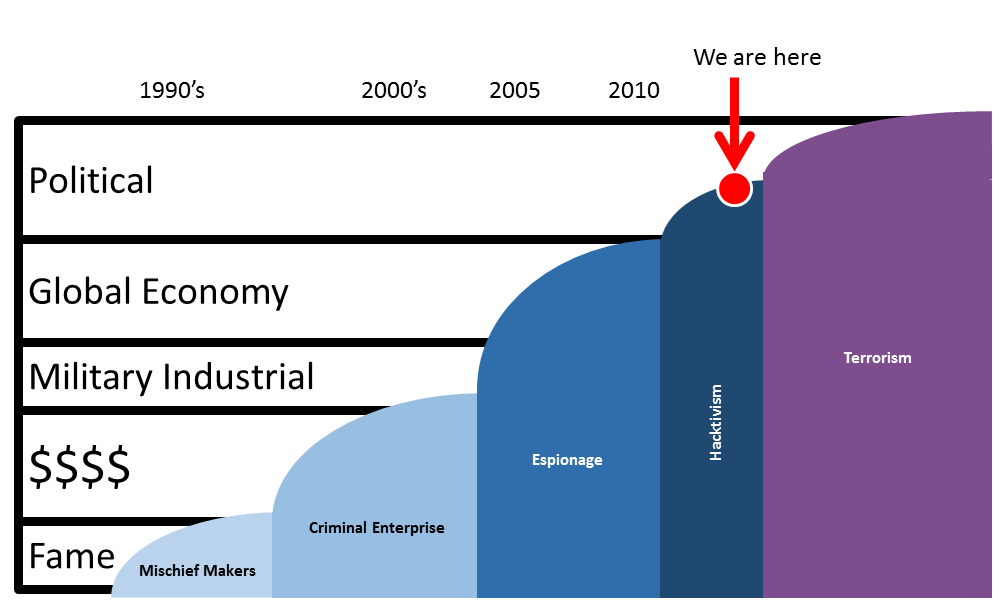
At my recent RSA presentation, I talked about the evolution of cyber threats over the last decade and the slowly shifting goals and intent of the hacking groups behind them. Most of us remember the romantic hacker vision - the lone college student exploring systems for fun, not profit. Mostly harmless, this quest for learning at the center of the hacker ethic led to tremendous innovation in Silicon Valley and elsewhere. But the advent of online banking in the mid-2000's changed everything. The criminal goal became profit. This created a malware economy, and something I call the "weaponization of cyberspace" - a trend towards making cyber weapons easier and easier for non-programmers to use. Then, around 2005-ish, we started to see organized and wide-scale attacks into military and defense systems that seemed to originate from foreign intelligence. The malware behind these attacks were not altogether different from known toolkits (think Back Orifice 2000) - but far more interesting was the fact these toolkits were custom-made and each attack group seemed to compile their weapons from private source code. It didn't take long for these attackers to branch into commercial space - most specifically heavy industry and energy. This made sense from a national perspective as China's (and others') need to dominate the world energy market is critical to their expansion.


Now, with hactivism, non-state actors are targeting these very same systems. These rogue threats are focusing on manufacturing, defense, the financial sector, and more - organizations traditionally targeted by state-level espionage.

So, what is next?

While attitudes against the state are a common recurring theme in younger people in every nation, they rarely blossom into full-blown terrorism. Yet, that is exactly what is occurring right now. As cyber warfare shifts from a state-level coordinated espionage operation to unstructured personal action, the chance for attacks (both physical and cyber) on citizens and the livelihoods of innocent people increases dramatically. The Internet will play a big part in future terrorist attacks - not just because systems can be hacked, but also because of how the Internet has changed media and journalism. As I detailed in my post on Asymmetric Warfare and Cyber Terrorism last July, remember that terrorism is first and foremost about messaging. Exacerbating the lines of truth, the Internet mediasphere has surpassed all other forms of traditional journalism and has become an information weapon, disseminating propaganda in conjunction with social media campaigns far more effectively than a single actor detonating a car-bomb in Karachi could ever achieve.

I will be giving a webcast version of my RSA presentation next Wednesday (March 14th, 11AM PST) for those who are interested. The RSA registration link is here.

-Greg

Tuesday, July 26, 2011

Asymmetric Warfare and Cyber Terrorism

In the newly released document, “DoD Strategy for Operating in Cyberspace", the Pentagon states that “while the threat to intellectual property is often less visible than the threat to critical infrastructure, it may be the most pervasive cyber threat today.” Pervasive, yes – but not necessarily the most dangerous.

In 2003, I founded my company, with the help of the federal government’s Small Business Initiative Research (SBIR) program, to develop products to counter these advanced unknown, stealth cyberthreats today often referred to today within the security community as Advanced Persistent Threats (APT).

While the APT threat is significant, the attacker can take months or even sometimes years to steal the information. However, the recent attacks made by small hacking groups illustrate a highly more tangible, immediate, and potentially more severe form of economic damage. It is appropriate to classify these acts as asymmetric warfare, and possibly as a type of cyberterrorism.

In contrast to APT threat actors and other traditional cyber criminals, cyberterrorists are not motivated by monetary gain. Instead, the cyberterrorist wants to cause grave harm or economic damage as quickly as possible, and to get attention for it. Attacks may be economic, political, or even shutting down the power in the dead of winter. The technical aspects of the attack may be similar to APT, but the intent and goal is wholly different.

Cyberterrorism first was a buzzword in the late 90’s associated with power outages and explosions orchestrated over computer networks. These types of attacks seemed like the digital equivalent of IED’s. While traditional terrorists clearly use the Internet to recruit and communicate, we operate under the assumption that the ‘ground of action’ is still the physical world – think suicide bombers. But, recent events have shown that attacks don’t have to be kinetic to cause damage. The ground of action can be entirely in cyberspace and damages can be measured in billions of dollars of stock value and the threats to persons are very real.
Edit: There are different views on the definition of cyberterrorism. In 'Computer Attack and Cyberterrorism: Vulnerabilities and Policy Issues for Congress', Clay Wilson defines two forms of cyberterrorism:

Effects-based: Cyberterrorism exists when computer attacks result in effects that are disruptive enough to generate fear comparable to a traditional act of terrorism, even if done by criminals.

Intent-based: Cyberterrorism exists when unlawful or politically motivated computer attacks are done to intimidate or coerce a government or people to further a political objective, or to cause grave harm or severe economic damage.

Since the early 2000’s, ‘electronic jihadists’ (i.e., Younes Tsouli, Mohammad Peerbhoy, etc) and other hacking groups (many can be researched on www.zone-h.org) have been content with web defacement and the occasional DDOS. But, these actions never gained the media attention like the recent spree of hacks in 2011. This is, in part, due to the advent of social networking. Former British Prime Minister Margaret Thatcher once stated “Publicity is the oxygen of terrorism”. Anyone studied in matters of terrorism knows that the primary goal of terrorism is media attention. The act is secondary to the message.


Younes Tsouli and Mohammad Peerbhoy, both criminal hackers working with Islamic extremist groups (photos via Associated Press)


A small sampling of criminal hacking groups operating in the Middle East. All of these groups are at least as-skilled as the current Lulzsec/Anonymous hackers, as evidenced by similar techniques, use of SQL injection, etc. The myth that traditional terrorist groups don't have access to hacking skill is simply outdated. (groups via zone-h.org)


In the words of William Gibson, “Terrorism is ultimately about branding”. Every press release, tweet, and claim is part of that brand to raise awareness for their cause or message. And, the media can function as an extension of the group’s propaganda machine. As TechCrunch columnist Paul Carr recently pointed out in his piece on the media coverage of the now defunct LulzSec group, most journalists were all too happy to hop aboard the ‘Lulz Boat’ and parrot propaganda verbatim without a hint of criticism and provide ‘celebrity fluff’ reporting. Paul especially calls out online journalists and bloggers as “downright shameful” for showing support for these criminal hackers. Gene Spafford, the professor and director at Purdue University and a leading security expert, has also objected to how reporters romanticize criminal hackers, drawing a parallel to computer virus authors in the early 90’s portrayed as “swashbuckling, electronic pirates” (pointing out that their legacy is now costing billions in damages).

Even in recent days, reporters have used lofty, inconsistent terms such as “masked crusaders,” a “loose hacker movement” and an “online activist group” to describe Anonymous. The fear of retribution by the criminal hackers within this group is real. No one wants to become a target. News organizations need to take a step back and take a close look at how they are covering these incidents and make sure they aren't enabling these groups’ propaganda machine.
Edit: as a case in point, notice the significant lack of the word 'criminal' when media reports on Anonymous/Lulzsec. To illustrate, here is how reporters/bloggers described Anonymous in the 24 hours following the Monsanto/Booz Allen Hamilton attacks:

"Online activist collective" - CNET
"hacker group" -- IT Business Edge
"Hactivist collective" -- The Inquirer
"Hacking Group" -- MSNBC
"Hacktivist Group" -- SC Magazine
"Hacker Group" -- WSJ
"Hacker Group" -- Network World/IDG
"Notorius Hactivist Collective" -- The Register
"Group of hactivist computer-savvy hackers" -- Economist
"Loose-hacker movement" -- Forbes
"Masked crusaders" -- Time
"Cyber-activist group" -- Financial Times
"Hacker Group" -- Dark Reading
"Online Activist Group" -- Associated Press
"Hacker Group" -- BBC News
"Hacking collective" -- NY Times
"Hacker Group" -- Washington Post

While the threat landscape is always changing, we must continue to highlight that a real criminal is at the other end of the keyboard, and that he is persistent and will keep coming back. While the DoD outlines some important initiatives for a more secure cyberspace, we, as citizens, also have a role. Just as we all participate in our local neighborhood watch to keep our physical community safe, we, as Internet users, need to be vigilant and work together to ensure our cyberspace remains safe.

-Greg Hoglund